.png)


WHY CHOOSE THE TRANSPORTABLE RECOVERY SANDBLASTING STATION

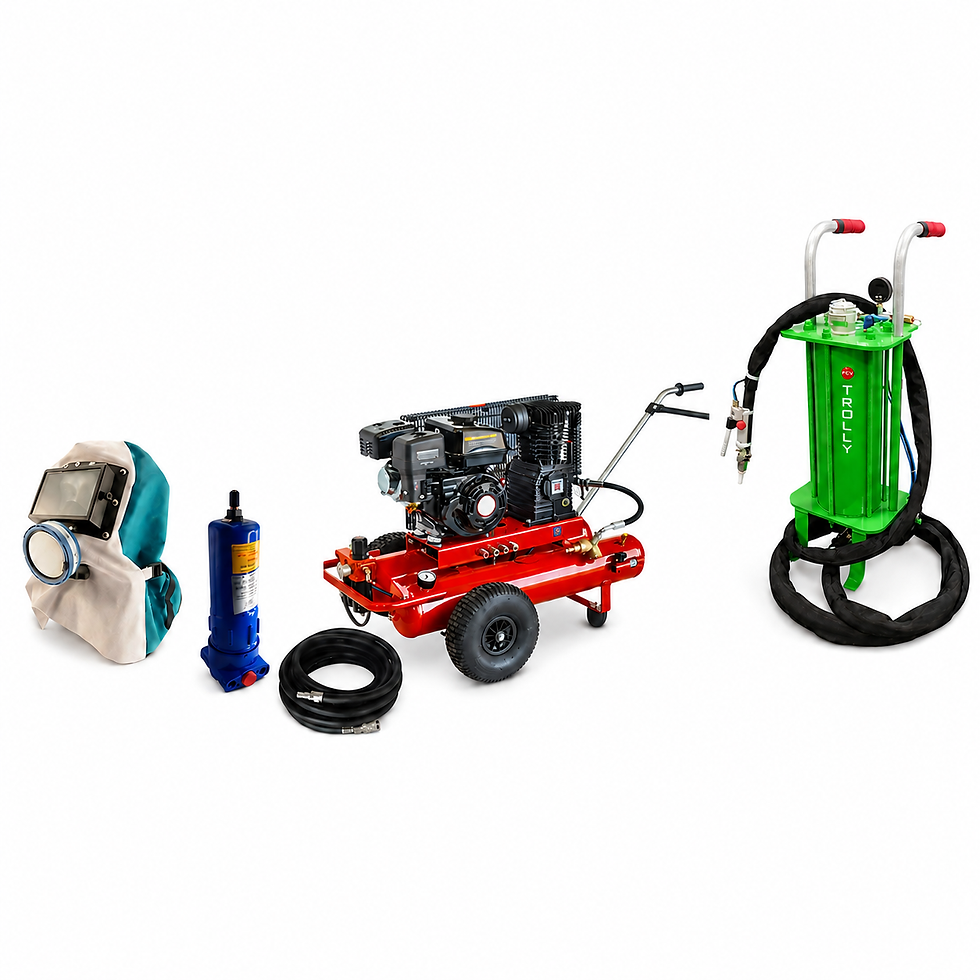
 The FEVI station is a complete system for carrying out recovery sandblasting operations directly on site, without having to have an air compressor already installed at the customer's or construction site's premises.

 The system integrates the PRESSURE BASE professional sandblaster, a TTS 34110/900 petrol compressor, 50 metres of connection hose and a condensate separator .

 PRESSURE BASE works with the gun body in contact with the surface: the abrasive used and the dust generated are sucked up and conveyed to the separation system, allowing the reusable abrasive to be recovered and limiting dispersion in the surrounding area.

 The compressor directly supplies the air needed by the sandblaster, making the system particularly useful for maintenance, construction sites, and external operations where an adequate compressed air network is not available.

 The configuration is designed to be loaded and transported with a suitable vehicle and brought directly to the intervention area.
Portable RECOVERY SANDBLASTING STATION
BASE PRESSURE – MAIN DATA
CHARACTERISTIC
DATA
Abrasive tank
24 liters
Standard nozzle
Widia Ø 4 mm
Operating pressure
2.5 – 7.8 bar
Air consumption at 7 bar
700 – 2,000 l/min
Abrasive recovery
Through gun body and suction
Abrasive/dust separation
Cyclone
Vacuum cleaner power
1,500 W
Vacuum cleaner power supply
220/240 V – 50 Hz
Suction flow rate
306 m³/h
Drum capacity
41 liters
Filtering surface
5,000 cm²
Filter shaker
Semi-automatic
Filtration class
M/H
TTS 34110/900 MOTOR COMPRESSOR – MAIN DATA
CHARACTERISTIC
DATA
Diet
Petrol, 4 stroke
Start-up
Electric with battery
Air flow rate
900 l/min
Maximum pressure
11 bars
Reservoir
17 + 17 liters
Header
K30, 2 cylinders / 2 stages
Regime
1,250 rpm
Weight
167 kg
Dimensions
1,150 × 751 × 1,070 mm
Movement
Pneumatic wheels and handles
PDF Pressure-Based Recovery Sandblaster
The performance of a sandblaster depends directly on the amount of compressed air available.
The station uses a 900 l/min compressor, eliminating the need to connect the PRESSURE BASE to a compressor already present at the intervention site.
This configuration favors portability, practicality and localized interventions.
It's important to note, however, that PRESSURE BASE may require higher flow rates depending on the pressure and operating conditions. The 900 l/min compressor is therefore not sized to exploit the machine's entire maximum air consumption range, but rather for a configuration geared towards mobility and processing compatible with the available flow rate.
WHEN TO CHOOSE A TRANSPORTABLE STATION
The station is particularly suitable when:
- it is necessary to intervene directly at the customer's premises or on the construction site;
- there is no adequate compressed air network available;
- the work involves localized areas;
- you want to recover the abrasive during processing;
- it is important to limit the dispersion of abrasive and dust;
- you need to have a complete configuration already sized in its main components;
- The distance from the work area makes the 50-meter connection useful.
WHEN TO PREFER A CONFIGURATION WITH HIGHER AIR FLOW
If the goal is to obtain the maximum possible productivity from the BASE PRESSURE or to tackle very large and continuous jobs, it may be more appropriate to use a compressor with a higher flow rate.
The 900 l/min compressor is in fact a choice oriented above all towards mobility and compressed air autonomy , while configurations with greater air availability allow you to exploit more demanding operating conditions.
The choice must therefore be made considering the surface to be treated, the material to be removed, the expected pressure, the abrasive and the required productivity.
WARNING: AUTONOMOUS COMPRESSED AIR, BUT REQUIRES ELECTRICITY
The petrol-powered compressor allows you to independently produce the compressed air needed by the sandblaster.
However, the PRESSURE BASE suction unit requires a single-phase 220/240 V power supply.
Before using the station on a construction site or in areas without an electrical network, it is therefore necessary to provide an adequate power source for the suction system.
Maintenance at the customer's premises
Localized interventions on artifacts, systems, and components that cannot be easily transported to the workshop.
Construction sites and external works
Use in places where a compressor with suitable characteristics for sandblasting is not available.
Localized removal of rust and paint
Treatment of limited areas on metal structures and artefacts with abrasive recovery.
Welding and carpentry
Preparation and localized treatment of weld seams, oxidations and metal areas affected by subsequent processing.
Stone, marble and architectural details
Localized interventions compatible with the surface, abrasive and the brush's ability to maintain correct contact.
Shipping costs will be partially deducted from the actual courier cost. The exact amount will be displayed during checkout.
Additional charges may apply for shipments to islands or remote areas. These will be communicated at the time of purchase or, if necessary, subsequently via email.
PALLETS AND LARGE PACKAGES
Shipments of bulky packages or pallets will be calculated based on volume, not just weight.NOTE FOR WEIGHT EQUAL TO OR GREATER THAN 100 KG
For bulky orders or orders weighing more than 100 kg, shipping will be done on a pallet and the rates will be calculated accordingly.Delivery times indicated on the website are approximate and not guaranteed. We cannot be held responsible for any delays due to circumstances beyond our control or attributable to the courier.
Customers are encouraged to consider purchasing a few days in advance to avoid any potential delays. However, we will do our best to ensure timely delivery.
COMPONENT
FUNCTION
Localized sandblasting with abrasive recovery
Compressed air production
Connection between compressor and sandblaster
Reduction of condensation in the supply air
What does the recovery sandblasting station include?
The configuration includes PRESSURE BASE, TTS 34110/900 compressor, 50 metres of connection hose and condensate separator.
Can the station work where there is no compressor?
Yes. The petrol-powered compressor directly produces the compressed air required for BASE PRESSURE, so it is not necessary to have a pneumatic network at the site of intervention.
Is the station completely autonomous?
It is autonomous in terms of compressed air production. However, the PRESSURE BASE suction unit requires a single-phase 220/240 V power supply, which must therefore be available or supplied separately.
Are the 900 l/min of the compressor sufficient for BASE PRESSURE?
BASE PRESSURE consumption varies depending on the configuration and working conditions. The 900 l/min compressor allows the machine to be used within a specific operating range, but it cannot exploit its full maximum air demand, which can reach up to 2,000 l/min.
What is the condensate separator used for?
It serves to reduce the amount of condensation present in the compressed air before it enters the sandblaster. Excessively humid air can compromise the regular flow of the abrasive.
Why use a regenerative sandblaster in a mobile station?
The recovery system allows for direct action on the affected area, recovering abrasive and dust during the process. It is particularly useful when traditional free-blast sandblasting would require greater preparation and confinement of the area.